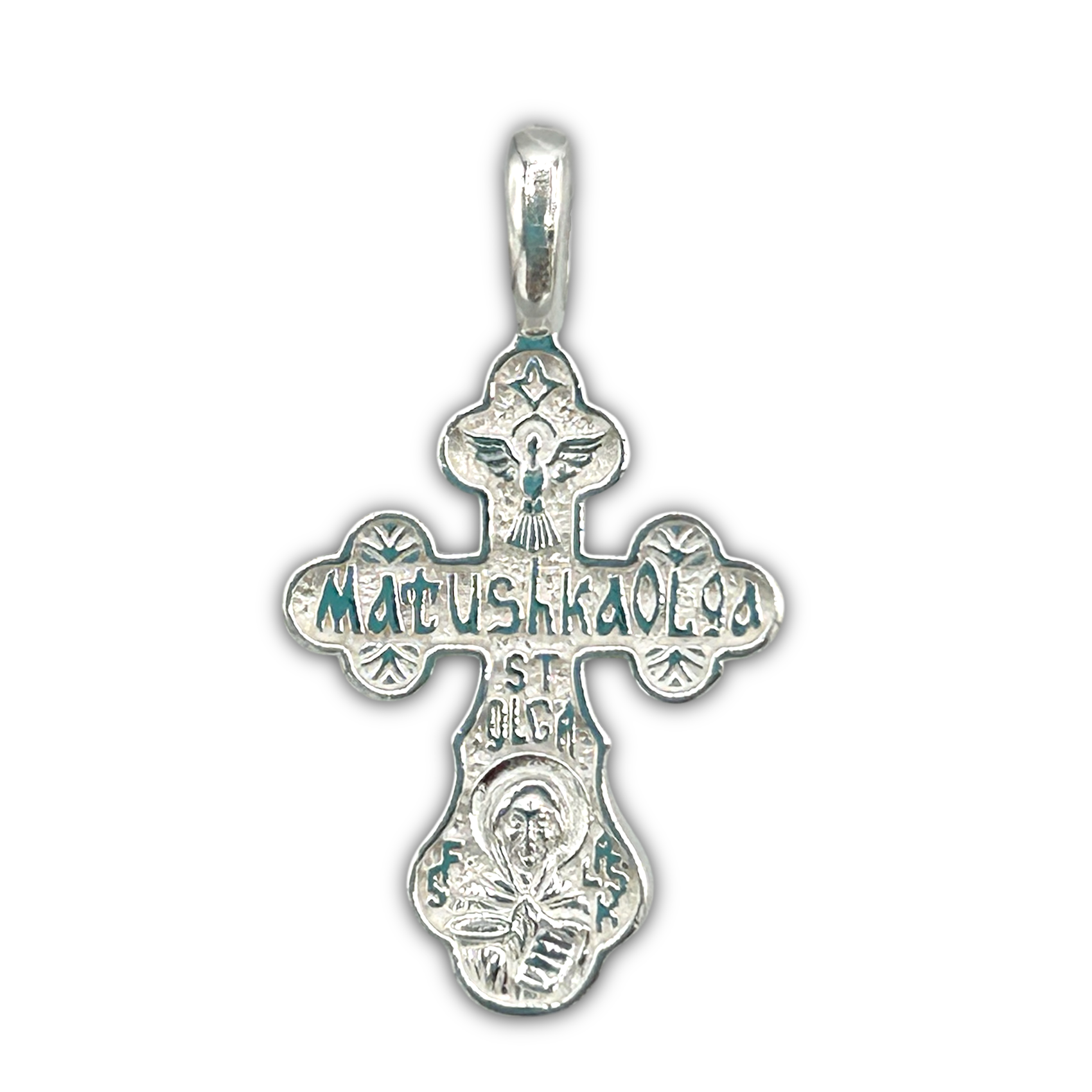
An Orthodox cross is more than a simple shape. Look closely at almost any neck cross and you’ll find letters, small figures and ornaments, each carrying part of the Gospel. Here is a short guide to the symbols you’ll see most often, using our St. Matushka Olga of Kwethluk cross as an example.
The shape of the cross
Many Orthodox crosses are “budded.” Each arm ends in three rounded lobes, a quiet reminder of the Holy Trinity. Other crosses, especially in the Russian tradition, have eight points: a short bar at the top for the title board, the main crossbar, and a slanted footrest below. The footrest points up toward the thief who repented and was promised Paradise, and down toward the one who did not.
The title board: ІНЦІ
Over Christ’s head Pilate placed a sign reading “Jesus of Nazareth, King of the Jews.” On Slavonic crosses it’s shortened to ІНЦІ. On Greek crosses you’ll see ΙΝΒΙ, and on Latin ones INRI. All three say the same thing.
IC XC and NIKA
On either side of Christ you’ll usually find IC XC, the first and last letters of “Jesus Christ” in Greek. Many crosses add NIKA, Greek for “conquers”: Jesus Christ conquers.
The walls of Jerusalem
Some crosses show a city wall behind the lower part of the cross. Christ was crucified outside the walls of Jerusalem, and the wall places the Crucifixion where it happened.
The skull of Adam
At the foot of many Orthodox crosses is a small skull, sometimes with crossed bones. By tradition, Golgotha, “the place of the skull,” is where Adam was buried. Christ’s blood falls on the first man, and through him all of humanity is redeemed. Death is shown beneath the Cross, defeated.
The Tree of Life
Small leaf-like sprigs often grow from the ends of the arms. They show the Cross as the Tree of Life: the tree of death in Eden becomes, through Christ, the tree that gives life.
The back of the cross
The back is where crosses differ most. Many Russian crosses carry a short prayer, such as “Save and preserve.” Others carry the image of a saint, so the wearer has a heavenly friend close to the heart.
A closer look: the St. Matushka Olga of Kwethluk cross
Our sterling silver Matushka Olga cross shows many of these symbols in one small piece. The front is a budded cross with the title board, IC XC, the walls of Jerusalem and the skull of Adam. The back is devoted to St. Olga:
- The Holy Spirit descends at the top as a haloed dove with rays beneath it.
- Her name runs across the crossbar, “Matushka Olga,” with “St. Olga” below.
- St. Olga herself stands at the base, with a halo and her headscarf, holding a bowl of water in honor of her work as a midwife.
- “Of Alsk” beside her is a shortened “of Alaska.” Abbreviations like this are common on Russian-style crosses, where space is tight.
Who was Matushka Olga?
St. Olga Michael was a Yup’ik priest’s wife and midwife from the village of Kwethluk, Alaska. She reposed in 1979 and was glorified as a saint of the Orthodox Church in June 2025. “Matushka,” meaning “mother,” is the loving title for a priest’s wife. She is remembered for her humility and her care for mothers, families and all who suffer. You can read more in our posts about the new items for her canonization and the Protectress of Kwethluk icon.
Choosing a cross
Whether you’re looking for a baptismal cross or a gift, knowing what the symbols mean makes the cross more personal. Browse our Orthodox neck crosses, or see the full Matushka Olga of Alaska Collection.